

No Surprises Here
We can see your true colors shining through

It’s been nearly four months since my last article. As the new year began and with my certificate in sustainability management in hand, I had every intention to throw myself into this substack. Yet life had other plans. In this case it was many tests and impatient waiting that led eventually to a diagnosis of Hodgkins Lymphoma for my husband and the start of chemo. There are still months to go on this journey, a journey my husband and I did not see coming but here we are, and the motto has been one day at a time. Through it all, I have been saving tabs upon tabs or articles and news around sustainability and greenwashing within the fashion and textile sphere for when some time finally opened up for me to sit down and start writing again.
It seems fitting that I pop back up here soon after the news of Everlane’s sale to Shein. There has been seemingly endless discourse around this on nearly every social platform. I appreciated some things said about it by Caroline Preibe, Harper Poe, and Shilpa Shah on LinkedIn. I noticed lot of people on the comments section speaking to some sort of “millennial dream” being dead with the $100 million acquisition. Much of that supposed dream was about sustainability yet was Everlane ever really sustainable? No, absolutely not. I remember when Everlane first hit the scene and started to gain popularity with their catch phrase of “radical transparency”. This was about price break down and spoke a bit to where a factory might be located. It made customers feel like they were getting a deal or that a company was being “honest” with them. Yet it was really a marketing ploy. None of their transparency spoke to how much pay was going to the people who were doing the farming, weaving, dyeing, cutting, and sewing or what the numbers were on the environmental impacts across the supply chain. Eventually they did jump on board with some sustainability campaigns, which mainly just meant using natural fibers in places and throwing around the term organic as well as promoting recycled polyester (which we now know to be a complete hoax and actually even worse for the planet). What surprised me was how much of the public seemed surprised/shocked or even upset by this transition for Everlane owned by fast fashion giant Shein. I realized that is because I forgot how good they were at marketing and getting people to believe they were a big brand trying to be “different” or “better”. Yet from the start they have always been a company started by an investor and software engineer in Silicon Valley with no background in clothing in order to make it big with profit. Part of what helped them was how many people, especially the millennial population (I’m a ‘geriatric millennial’ myself) were so eager and desperate to belief in what they were being told and in a fantasy of a large growing brand trying to be “good”.

Now some have blamed this so called failure of Everlane’s on the issues surrounding all their venture capital and private equity. Taking on those investments meant growth at all and any costs. This is true but that is not why Everlane was loosing money (and value), which led to them ultimately needing to find a buyer willing to pay a decent amount. The founders Michael Preysman and Jesse Farmer did not start the company as a nonprofit to help make any real change and progress in the industry. No, they started Everlane to make money and play into the boom that was happening at the time within the DTC markets (think Allbirds, Warby Parker, Glossier, Casper, Away). Ultimately, the issue was they never were providing anything truly new, not in style or product and not within any real sustainability initiatives. At the beginning they were primarily focused on basics with a break down of costs, then they tried to be considered sustainable, and then tried to have some sort of design point of view which never landed properly. I spoke to this in my August 2025 article The Luxury Lie with reference to a strange Everlane campaign of stiff looking models in a barren field.
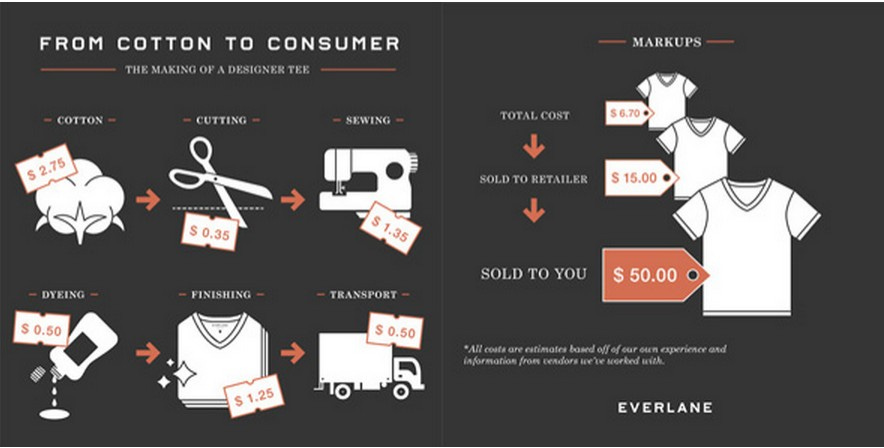
Above, some of Everlane’s original marketing around “radical transparency”


Above, their unbecoming campaign about “clean luxury” and then in November of 2025 their new monogram logo (trying to make themselves look oh so fancy)
